Decoding Website Trust Signals: A Pragmatic Case Study for Growth Agencies
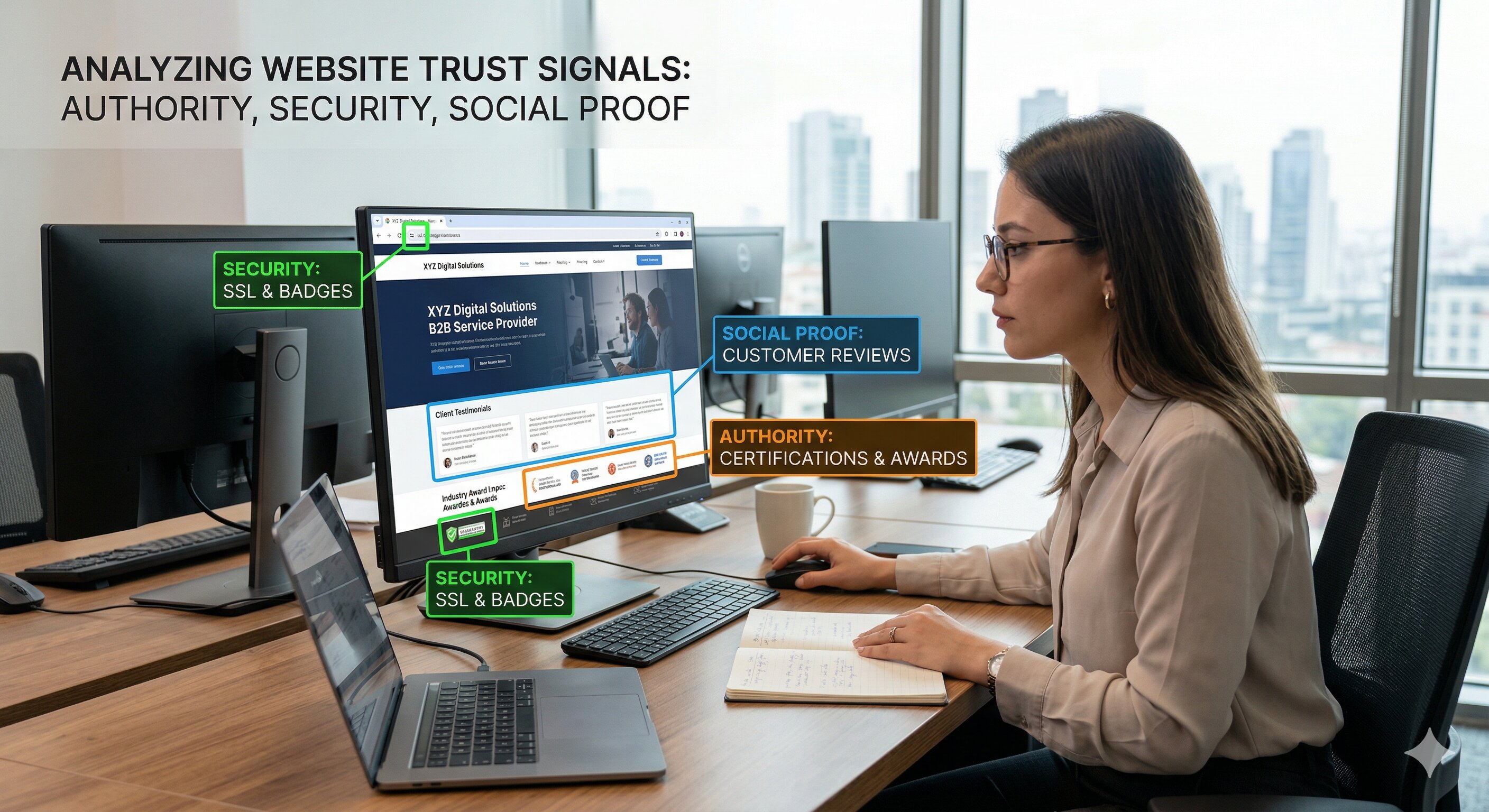
This article provides a detailed analysis of website trust signals, focusing on their importance for growth agencies. Utilizing a practical case study, we explore decision criteria, frameworks, and actionable insights to enhance your website's credibility.
Understanding Trust Signals on Websites
In today's digital landscape, establishing trust is essential for converting visitors into customers. Trust signals are elements on a website that indicate legitimacy, credibility, and security. This analysis will delve into various types of trust signals and their impact on user behavior.
The Framework for Analyzing Trust Signals
For effective assessment, we can use a trust signal framework that categorizes these signals into three core areas: Authority, Security, and Social Proof.
- Authority: Includes credentials, awards, and certifications that highlight expertise.
- Security: Features that ensure the protection of user data, such as SSL certificates and secure payment gateways.
- Social Proof: Testimonials, reviews, and user-generated content that demonstrate satisfaction.
Case Study: Analyzing Trust Signals of a Local B2B Service Provider
To illustrate the impact of trust signals, we analyzed the website of a local B2B service provider—XYZ Solutions. By applying our framework, we found key strengths and weaknesses:
| Trust Signal | Strength | Weakness |
|---|---|---|
| SSL Certificate | Yes | N/A |
| Client Testimonials | Prominent on homepage | Lack of full names |
| Awards & Certifications | Displayed strategically | Outdated information |
| Security Badges | Multiple trusted badges | Not clickable for verification |
Actionable Insights: Enhancing Trust Signals
From our analysis, several actionable insights emerged that can help XYZ Solutions enhance its trust signals:
- Update Credentials: Ensure that all awarded certifications and recognitions are current. Outdated information can erode trust.
- Validating Social Proof: Use full names and pictures of clients in testimonials to increase authenticity.
- Clickable Security Badges: Make security badges clickable to provide users with verification options.
- Implement Live Chat: Adding a live chat feature can provide immediate assistance, reinforcing trust.
Monitoring and Iterating on Trust Signals
Once improvements are in place, ongoing monitoring is crucial. Use analytics tools to track user behavior and conversion rates. Regularly solicit feedback from users regarding their perceptions of trust signals.
Consider setting a timeline for reviewing these trust elements, ideally every quarter, to remain agile and responsive to user expectations.
FAQ Section
What are the most critical trust signals for a website?
The most critical trust signals include SSL certificates, recognizable security badges, client testimonials, and clear contact information.
How can I test the effectiveness of my trust signals?
Use A/B testing to compare different versions of trust signals on your site and analyze their impact on conversion rates.
Are trust signals the same for B2B and B2C websites?
While many trust signals overlap, B2B websites may emphasize professional certifications and case studies, whereas B2C sites might focus more on customer reviews and ratings.
How often should I update my trust signals?
It's recommended to review and update your trust signals at least quarterly or whenever you receive new accolades or client feedback.