Harnessing Behavioral Signals for Prospect Prioritization: A Data-Driven Approach
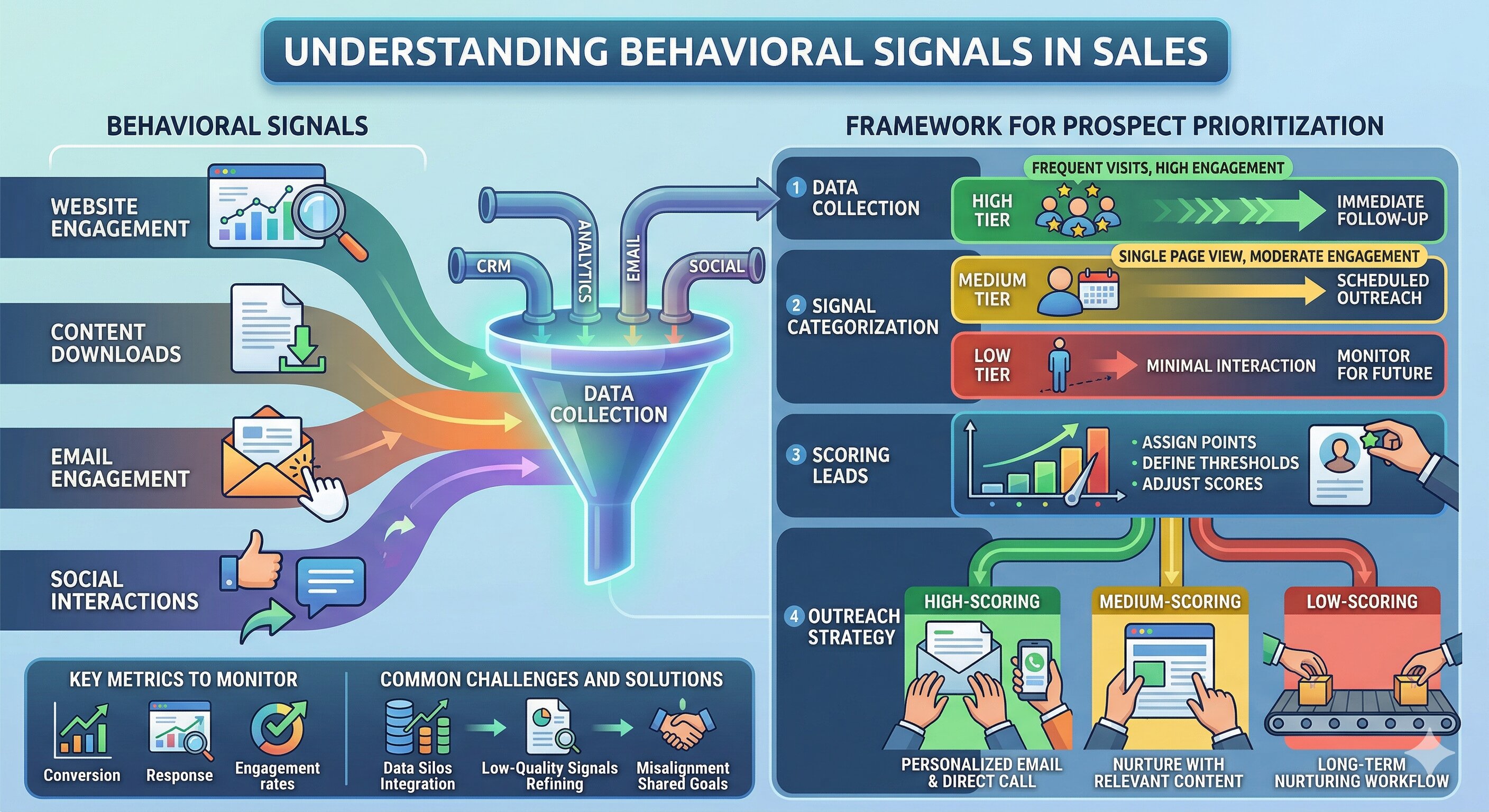
Discover a comprehensive framework for prospect prioritization through behavioral signals, tailored for growth agencies and B2B service providers. Learn actionable strategies backed by data to improve your sales outcomes.
Understanding Behavioral Signals in Sales
Behavioral signals are actions or patterns exhibited by potential leads that indicate their readiness to engage, purchase, or explore services. By analyzing these signals, sales teams can prioritize outreach efforts, ensuring that resources are directed toward high-value prospects. Common behavioral signals include:
- Website engagement metrics (time spent on site, page views)
- Content downloads (whitepapers, case studies)
- Email engagement (open and click-through rates)
- Social media interactions (likes, shares, comments)
A Framework for Prospect Prioritization
The following steps outline a practical framework for prioritizing prospects based on their behavioral signals:
Step 1: Data Collection
Gather relevant data from various touchpoints:
- Customer Relationship Management (CRM) systems
- Website analytics platforms (e.g., Google Analytics)
- Email marketing platforms (e.g., Mailchimp)
- Social media analytics tools
Step 2: Signal Categorization
Once data is collected, categorize the signals into three tiers based on urgency:
| Tier | Behavioral Signals | Response Action |
|---|---|---|
| High | Frequent visits, high engagement | Immediate follow-up |
| Medium | Single page view, moderate engagement | Scheduled outreach |
| Low | Minimal interaction | Monitor for future engagement |
Step 3: Scoring Leads
Implement a scoring system to quantify the value of prospects based on their engagement:
- Assign points for each behavioral signal
- Define a scoring threshold for active leads
- Adjust scores based on business priorities
Step 4: Outreach Strategy
Develop a targeted outreach strategy based on the score:
- High-scoring leads receive personalized emails and direct calls
- Medium-scoring leads are nurtured with relevant content
- Low-scoring leads enter a long-term nurturing workflow
Key Metrics to Monitor
To assess the effectiveness of your prioritization strategy, regularly review these key metrics:
- Conversion rates associated with high, medium, and low-tier leads
- Response rates to outreach efforts
- Engagement metrics from nurturing campaigns
Common Challenges and Solutions
While implementing this framework, you may encounter challenges such as data silos or inconsistent signal tracking. Here’s how to address them:
- Challenge: Incomplete data collection.
Solution: Integrate tools to centralize data analysis and tracking. - Challenge: Overwhelmed by low-quality signals.
Solution: Refine signal definitions to focus on the most actionable behaviors. - Challenge: Difficulty in aligning sales and marketing teams.
Solution: Foster communication through shared goals and regular strategy meetings.
FAQ
What are behavioral signals?
Behavioral signals are indicators of a prospect’s interest and engagement, derived from their actions across various platforms.
How can I effectively measure behavioral signals?
Utilize analytics tools and CRM systems to track and analyze prospects' engagement with your content and communications.
What is the importance of lead scoring?
Lead scoring helps prioritize outreach efforts, ensuring that sales resources are allocated to the most promising prospects based on their engagement levels.
Can this framework be adapted for different industries?
Yes, this framework is flexible and can be tailored to fit various industries and business models by adjusting the behavioral signals and scoring criteria.